Human cladogram with traits: http://evolution.berkeley.edu/evosite/evo101/images/patterns_intro.gif
Skeletal progression: http://www.como.wa.edu.au/uploads/media/bipedal1.jpg
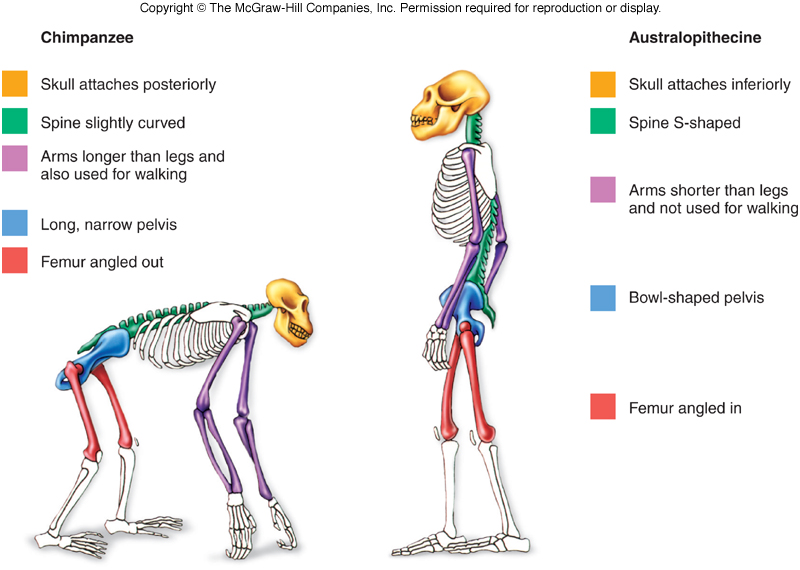
Skeletal comparison between chimp and Australopithicus: http://www.zo.utexas.edu/faculty/sjasper/images/f27.5.jpg
Ardi: http://en.wikipedia.org/wiki/Ardi
(Note that it is not known whether this is a human ancestor, but s/he is a hominin)
Article from Scientific American about the finding of a skull that may be an early human: http://blogs.scientificamerican.com/observations/2013/04/04/brain-shape-confirms-controversial-fossil-as-oldest-human-ancestor/
Early Modern Homo Sapiens: http://anthro.palomar.edu/homo2/mod_homo_4.htm
Wednesday, April 24, 2013


Thursday, April 4, 2013
DNA Replication, Protein Synthesis, Personal Genomes and Pipelines, Oh my!
So far this week in class, we've covered two main topics: DNA replication and protein synthesis.
If you are interested in learning more about either process, you can visit youtube.com. There are many videos that will walk you through each process.
I especially enjoyed this video.
During our discussion on DNA, I mentioned a service provided by 23andMe. For $99 per individual, you can have your genetic information analyzed for ethnic origin and health information. I did this for myself and my children and discovered some very interesting things about each of us.
Finally, I shared a news article pertaining to oil pipelines with the students today. Their assignment is to read it and we will discuss the issue in depth tomorrow. You may read the article by clicking here. This issue is one that I am mentioning because a Canadian company is building a tar sand pipeline through Northwest Indiana and much of the Northeastern United States. The consequences of these pipelines are loss of wetlands (and despite legislation requiring mitigation of wetlands lost to such projects, not all wetlands are created equal) and potential leaks or breaks which could have catastrophic results. This project is happening locally (this morning I saw the company's vehicle parked on our property) and will very likely have a large impact on our immediate environment.
As always, if you have questions, do not hesitate to contact me.
Tuesday, March 5, 2013
VDA#8 Critical Thinking Skills, CO2 Emissions & Extra Credit
Today somebody shared this article with me. While Mr. Orcutt may be correct about cyclists emitting more CO2 than their counterparts driving inside of gasoline-fueled vehicles, his final assessment is less than accurate.
Your extra credit assignment is to write one well-formed paragraph, that reflects critical thinking, telling me whether or not Mr. Orcutt's proposal is based on logic and sound science. This paragraph is due by Thursday, March 7th, 4:30pm CST. It must be turned in to me, not posted on your blog.
While doing a very brief search on CO2 emissions from fuel combustion, I found this report put out by the International Energy Agency. I do not expect you to read the whole thing, however, I would like to note the following excerpt from the very first paragraph on page 7
Write one well-formed paragraph describing to me how the economy in developed countries has an impact on CO2 emissions. Further, cite two government or educational sources that you referenced for your paragraph. (The websites should end in .gov or .edu). Post your paragraph and the references on time for a shot at full credit.
Your extra credit assignment is to write one well-formed paragraph, that reflects critical thinking, telling me whether or not Mr. Orcutt's proposal is based on logic and sound science. This paragraph is due by Thursday, March 7th, 4:30pm CST. It must be turned in to me, not posted on your blog.
While doing a very brief search on CO2 emissions from fuel combustion, I found this report put out by the International Energy Agency. I do not expect you to read the whole thing, however, I would like to note the following excerpt from the very first paragraph on page 7
"Global CO2 emissions rose by 4.6% in 2010, after
having declined in 2009 due to the impact of the
financial crisis, in particular on Western economies."
VDA #8
assignment due: Friday, March 8th by 11:59pm CST
Write one well-formed paragraph describing to me how the economy in developed countries has an impact on CO2 emissions. Further, cite two government or educational sources that you referenced for your paragraph. (The websites should end in .gov or .edu). Post your paragraph and the references on time for a shot at full credit.
Thursday, February 21, 2013
Tuesday, February 12, 2013
VDA 7: The Wonder of Scat
VDA#7
Due: Friday, February 15; 11:59pm CST
Directions: Read the article entitled Delving into Dung and:
a)answer the following questions in complete sentences
b)use your own words
c) be sure to use the article when answering the questions. The answers are all found within the article, with exception to the last question! For that question, you must use your own brain (or, do a quick google search).
d) If there are two or more questions, highlight the question and the answer appropriately in your post.
e) Don't forget to label your VDA post as VDA7
Good luck!
1. What is the benefit of checking feces (poop, scat, dung, droppings) for hormones versus checking the blood of the animal?
2. What four things can you learn from an organism's droppings?
3. What hormone is produced when some animals are stressed or starving?
4. What did the researchers conclude contributed to the higher stress in orcas and how did the scientists come to that conclusion?
5. Give two reasons why dung beetles climb atop the balls of dung.
6. What is the relationship between the Kakapo and the Hades flowers? In your answer, be sure to include how each species benefits the other.
7. Why is the Hades flower called "Hades" flower?
Wednesday, February 6, 2013
Online Reading Quizzes
I have signed up for an account at QuizStar.
We will now be taking reading quizzes online. Here's how you can do it:
We will now be taking reading quizzes online. Here's how you can do it:
1) Go to:
quizstar.4teachers.org
2) Click yellow arrow on right side “student site”
3) Type in your username and password.
4) Once in, you will see a notification “1 untaken
quiz”. Click on that.
5) You will see three lists of quizzes. Under “untaken quizzes” click “take” on the
most recent quiz.
I will periodically assign reading quizzes. You will be given the information in class
and it is up to you to take the quiz before it closes. Note that each quiz has a close
date/time. Be sure to take the quiz
before that time to earn the credit for the assignment.
Your first online quiz is for chapter 9, section 3 on viruses. It is open now and closes Friday at 11:45pm. good luck!
Monday, January 28, 2013
Experimental Validity & Class Effort
Experimental Validity & Resulting Conversation
In class today, we discussed the concept of validity as it pertains to experimentation. Due to the fact that many students could not accurately answer a question pertaining to validity on their last VDA (#6), I thought I would spend a class period discussing it.
As part of our conversation, we discussed social phenomena and their effect on an experiment's results. I mentioned reading an article about how humans relate to machines. In addition, we discussed a classical psychological experiment that Milgram performed in 1961. Both experiments are heavily influenced by the times in which they were performed.
Effort
In an effort to deliver students and parents an accurate picture of their students' performance, I have decided to give each student two grades for science. The first grade will be a reflection of your students' performance in the content area. Specifically, it will reflect the grades they earn on the homework.
The second grade they will earn in science will be contingent upon their effort in class. This grade will be determined by calculating a pass (100)/fail (0) for each assignment. If they turn the work in, on time AND complete, then it will receive a 100%. If not, it will earn a 0%. To be clear, if they turn in an assignment two days late, they will receive appropriate credit for the assignment, but their science effort grade will suffer the 0%.
Example:
Student A turns in the following assignments:
Assignment 1
earned: 100% (missed 0 questions)
turned in: on time (100% effort)
Assignment 2
earned: 80% (missed 2 of 10 questions)
turned in: late (0% effort)
Assignment 3
earned: 90% (missed 1 of 10 questions)
turned in: on time (100% effort)
Assignment 4
earned: 100% (missed 0 questions)
turned in: late (0% effort)
Assignment 5
earned: 70% (missed 3 of 10 questions)
turned in: late (0% effort)
Their grades would be as follows:
earned: 88%, B+
effort: 40%, F
What that means for you, parents and students, is that you know the student would have likely earned a higher grade if they put more effort into the class. Whereas, if a student earns an 88% and has an effort of 100%, you can be confident that your child worked to the best of his/her ability.
Please note: my class grade is weighted by category whereas the effort grade will not be weighted.
Extra Credit Reminders
1)Page 177 Challenge: Create a power point answering all of the questions. The more effort you put into the presentation, the more points you will earn. (Due: Monday, February 4th)
2) Wrinkly finger experiment: Put one hand in salt water, the other in fresh water. Be sure that temperature and time of exposure is constant. Take photographs of your finger tips and upload them to your blog. (Due: Friday, February 1st)
Subscribe to:
Posts (Atom)