Tuesday, May 21, 2013
Periodic Table....in song :)
Ameer shared this link with me and so I am forwarded it along. Here you go!

Sunday, May 12, 2013
VDA#9 Potential
VDA #9: POTENTIAL
due: Wednesday, May 15, 11:59pm
Read this article and write two paragraphs, one addressing each question:
1) Consider the potential of these 3-D machines, what object would you print that could help the world? Why?
2) From a selfish standpoint, what one item would you print for yourself? Why?
REMEMBER: Use "VDA#9: Potential" as your subject line for your blog post.
As an added bonus, in honor of Mother's Day, here is an article about the world's oldest albatross becoming a mom again... click here.
Wednesday, April 24, 2013
Lecture Resources (4/24/2013)
Human cladogram with traits: http://evolution.berkeley.edu/evosite/evo101/images/patterns_intro.gif
Skeletal progression: http://www.como.wa.edu.au/uploads/media/bipedal1.jpg
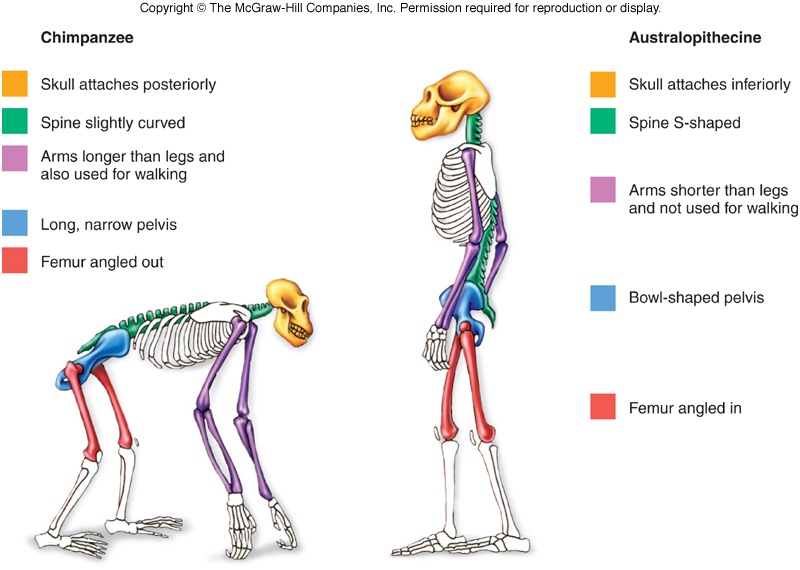
Skeletal comparison between chimp and Australopithicus: http://www.zo.utexas.edu/faculty/sjasper/images/f27.5.jpg
Ardi: http://en.wikipedia.org/wiki/Ardi
(Note that it is not known whether this is a human ancestor, but s/he is a hominin)
Article from Scientific American about the finding of a skull that may be an early human: http://blogs.scientificamerican.com/observations/2013/04/04/brain-shape-confirms-controversial-fossil-as-oldest-human-ancestor/
Early Modern Homo Sapiens: http://anthro.palomar.edu/homo2/mod_homo_4.htm
Skeletal progression: http://www.como.wa.edu.au/uploads/media/bipedal1.jpg
Skeletal comparison between chimp and Australopithicus: http://www.zo.utexas.edu/faculty/sjasper/images/f27.5.jpg
Ardi: http://en.wikipedia.org/wiki/Ardi
(Note that it is not known whether this is a human ancestor, but s/he is a hominin)
Article from Scientific American about the finding of a skull that may be an early human: http://blogs.scientificamerican.com/observations/2013/04/04/brain-shape-confirms-controversial-fossil-as-oldest-human-ancestor/
Early Modern Homo Sapiens: http://anthro.palomar.edu/homo2/mod_homo_4.htm
Thursday, April 4, 2013
DNA Replication, Protein Synthesis, Personal Genomes and Pipelines, Oh my!
So far this week in class, we've covered two main topics: DNA replication and protein synthesis.
If you are interested in learning more about either process, you can visit youtube.com. There are many videos that will walk you through each process.
I especially enjoyed this video.
During our discussion on DNA, I mentioned a service provided by 23andMe. For $99 per individual, you can have your genetic information analyzed for ethnic origin and health information. I did this for myself and my children and discovered some very interesting things about each of us.
Finally, I shared a news article pertaining to oil pipelines with the students today. Their assignment is to read it and we will discuss the issue in depth tomorrow. You may read the article by clicking here. This issue is one that I am mentioning because a Canadian company is building a tar sand pipeline through Northwest Indiana and much of the Northeastern United States. The consequences of these pipelines are loss of wetlands (and despite legislation requiring mitigation of wetlands lost to such projects, not all wetlands are created equal) and potential leaks or breaks which could have catastrophic results. This project is happening locally (this morning I saw the company's vehicle parked on our property) and will very likely have a large impact on our immediate environment.
As always, if you have questions, do not hesitate to contact me.
I especially enjoyed this video.
During our discussion on DNA, I mentioned a service provided by 23andMe. For $99 per individual, you can have your genetic information analyzed for ethnic origin and health information. I did this for myself and my children and discovered some very interesting things about each of us.
Finally, I shared a news article pertaining to oil pipelines with the students today. Their assignment is to read it and we will discuss the issue in depth tomorrow. You may read the article by clicking here. This issue is one that I am mentioning because a Canadian company is building a tar sand pipeline through Northwest Indiana and much of the Northeastern United States. The consequences of these pipelines are loss of wetlands (and despite legislation requiring mitigation of wetlands lost to such projects, not all wetlands are created equal) and potential leaks or breaks which could have catastrophic results. This project is happening locally (this morning I saw the company's vehicle parked on our property) and will very likely have a large impact on our immediate environment.
As always, if you have questions, do not hesitate to contact me.
Tuesday, March 5, 2013
VDA#8 Critical Thinking Skills, CO2 Emissions & Extra Credit
Today somebody shared this article with me. While Mr. Orcutt may be correct about cyclists emitting more CO2 than their counterparts driving inside of gasoline-fueled vehicles, his final assessment is less than accurate.
Your extra credit assignment is to write one well-formed paragraph, that reflects critical thinking, telling me whether or not Mr. Orcutt's proposal is based on logic and sound science. This paragraph is due by Thursday, March 7th, 4:30pm CST. It must be turned in to me, not posted on your blog.
While doing a very brief search on CO2 emissions from fuel combustion, I found this report put out by the International Energy Agency. I do not expect you to read the whole thing, however, I would like to note the following excerpt from the very first paragraph on page 7
Write one well-formed paragraph describing to me how the economy in developed countries has an impact on CO2 emissions. Further, cite two government or educational sources that you referenced for your paragraph. (The websites should end in .gov or .edu). Post your paragraph and the references on time for a shot at full credit.
Your extra credit assignment is to write one well-formed paragraph, that reflects critical thinking, telling me whether or not Mr. Orcutt's proposal is based on logic and sound science. This paragraph is due by Thursday, March 7th, 4:30pm CST. It must be turned in to me, not posted on your blog.
While doing a very brief search on CO2 emissions from fuel combustion, I found this report put out by the International Energy Agency. I do not expect you to read the whole thing, however, I would like to note the following excerpt from the very first paragraph on page 7
"Global CO2 emissions rose by 4.6% in 2010, after
having declined in 2009 due to the impact of the
financial crisis, in particular on Western economies."
VDA #8
assignment due: Friday, March 8th by 11:59pm CST
Write one well-formed paragraph describing to me how the economy in developed countries has an impact on CO2 emissions. Further, cite two government or educational sources that you referenced for your paragraph. (The websites should end in .gov or .edu). Post your paragraph and the references on time for a shot at full credit.
Thursday, February 21, 2013
Tuesday, February 12, 2013
VDA 7: The Wonder of Scat
VDA#7
Due: Friday, February 15; 11:59pm CST
Directions: Read the article entitled Delving into Dung and:
a)answer the following questions in complete sentences
b)use your own words
c) be sure to use the article when answering the questions. The answers are all found within the article, with exception to the last question! For that question, you must use your own brain (or, do a quick google search).
d) If there are two or more questions, highlight the question and the answer appropriately in your post.
e) Don't forget to label your VDA post as VDA7
Good luck!
1. What is the benefit of checking feces (poop, scat, dung, droppings) for hormones versus checking the blood of the animal?
2. What four things can you learn from an organism's droppings?
3. What hormone is produced when some animals are stressed or starving?
4. What did the researchers conclude contributed to the higher stress in orcas and how did the scientists come to that conclusion?
5. Give two reasons why dung beetles climb atop the balls of dung.
6. What is the relationship between the Kakapo and the Hades flowers? In your answer, be sure to include how each species benefits the other.
7. Why is the Hades flower called "Hades" flower?
Wednesday, February 6, 2013
Online Reading Quizzes
I have signed up for an account at QuizStar.
We will now be taking reading quizzes online. Here's how you can do it:
We will now be taking reading quizzes online. Here's how you can do it:
1) Go to:
quizstar.4teachers.org
2) Click yellow arrow on right side “student site”
3) Type in your username and password.
4) Once in, you will see a notification “1 untaken
quiz”. Click on that.
5) You will see three lists of quizzes. Under “untaken quizzes” click “take” on the
most recent quiz.
I will periodically assign reading quizzes. You will be given the information in class
and it is up to you to take the quiz before it closes. Note that each quiz has a close
date/time. Be sure to take the quiz
before that time to earn the credit for the assignment.
Your first online quiz is for chapter 9, section 3 on viruses. It is open now and closes Friday at 11:45pm. good luck!
Monday, January 28, 2013
Experimental Validity & Class Effort
Experimental Validity & Resulting Conversation
In class today, we discussed the concept of validity as it pertains to experimentation. Due to the fact that many students could not accurately answer a question pertaining to validity on their last VDA (#6), I thought I would spend a class period discussing it.
As part of our conversation, we discussed social phenomena and their effect on an experiment's results. I mentioned reading an article about how humans relate to machines. In addition, we discussed a classical psychological experiment that Milgram performed in 1961. Both experiments are heavily influenced by the times in which they were performed.
Effort
In an effort to deliver students and parents an accurate picture of their students' performance, I have decided to give each student two grades for science. The first grade will be a reflection of your students' performance in the content area. Specifically, it will reflect the grades they earn on the homework.
The second grade they will earn in science will be contingent upon their effort in class. This grade will be determined by calculating a pass (100)/fail (0) for each assignment. If they turn the work in, on time AND complete, then it will receive a 100%. If not, it will earn a 0%. To be clear, if they turn in an assignment two days late, they will receive appropriate credit for the assignment, but their science effort grade will suffer the 0%.
Example:
Student A turns in the following assignments:
Assignment 1
earned: 100% (missed 0 questions)
turned in: on time (100% effort)
Assignment 2
earned: 80% (missed 2 of 10 questions)
turned in: late (0% effort)
Assignment 3
earned: 90% (missed 1 of 10 questions)
turned in: on time (100% effort)
Assignment 4
earned: 100% (missed 0 questions)
turned in: late (0% effort)
Assignment 5
earned: 70% (missed 3 of 10 questions)
turned in: late (0% effort)
Their grades would be as follows:
earned: 88%, B+
effort: 40%, F
What that means for you, parents and students, is that you know the student would have likely earned a higher grade if they put more effort into the class. Whereas, if a student earns an 88% and has an effort of 100%, you can be confident that your child worked to the best of his/her ability.
Please note: my class grade is weighted by category whereas the effort grade will not be weighted.
Extra Credit Reminders
1)Page 177 Challenge: Create a power point answering all of the questions. The more effort you put into the presentation, the more points you will earn. (Due: Monday, February 4th)
2) Wrinkly finger experiment: Put one hand in salt water, the other in fresh water. Be sure that temperature and time of exposure is constant. Take photographs of your finger tips and upload them to your blog. (Due: Friday, February 1st)
In class today, we discussed the concept of validity as it pertains to experimentation. Due to the fact that many students could not accurately answer a question pertaining to validity on their last VDA (#6), I thought I would spend a class period discussing it.
As part of our conversation, we discussed social phenomena and their effect on an experiment's results. I mentioned reading an article about how humans relate to machines. In addition, we discussed a classical psychological experiment that Milgram performed in 1961. Both experiments are heavily influenced by the times in which they were performed.
Effort
In an effort to deliver students and parents an accurate picture of their students' performance, I have decided to give each student two grades for science. The first grade will be a reflection of your students' performance in the content area. Specifically, it will reflect the grades they earn on the homework.
The second grade they will earn in science will be contingent upon their effort in class. This grade will be determined by calculating a pass (100)/fail (0) for each assignment. If they turn the work in, on time AND complete, then it will receive a 100%. If not, it will earn a 0%. To be clear, if they turn in an assignment two days late, they will receive appropriate credit for the assignment, but their science effort grade will suffer the 0%.
Example:
Student A turns in the following assignments:
Assignment 1
earned: 100% (missed 0 questions)
turned in: on time (100% effort)
Assignment 2
earned: 80% (missed 2 of 10 questions)
turned in: late (0% effort)
Assignment 3
earned: 90% (missed 1 of 10 questions)
turned in: on time (100% effort)
Assignment 4
earned: 100% (missed 0 questions)
turned in: late (0% effort)
Assignment 5
earned: 70% (missed 3 of 10 questions)
turned in: late (0% effort)
Their grades would be as follows:
earned: 88%, B+
effort: 40%, F
What that means for you, parents and students, is that you know the student would have likely earned a higher grade if they put more effort into the class. Whereas, if a student earns an 88% and has an effort of 100%, you can be confident that your child worked to the best of his/her ability.
Please note: my class grade is weighted by category whereas the effort grade will not be weighted.
Extra Credit Reminders
1)Page 177 Challenge: Create a power point answering all of the questions. The more effort you put into the presentation, the more points you will earn. (Due: Monday, February 4th)
2) Wrinkly finger experiment: Put one hand in salt water, the other in fresh water. Be sure that temperature and time of exposure is constant. Take photographs of your finger tips and upload them to your blog. (Due: Friday, February 1st)
Thursday, January 24, 2013
Shakespeare's in Your DNA
Today we read this article. During our lesson, students learned the following:
waived: to pass on something (example given: waiving fees for an activity)
If you would like to learn more about binary code, you can do so here.
Students, questions? Comments? Leave them here...
Binary Code is the code that our computers "speak". It's a series of 0s and 1s that computer scientists use to tell computers what to do!
DNA PCR or DNA polymerase chain reaction, is a process by which geneticists take a small amount of DNA and copy it so that they have a larger amount. This makes it so that they can run a slew of tests on the DNA without needing a human to give a large sample.
new vocabulary:
redundant: an adjective that describes something that is repetitive. "Redundancies" is the plural form.
cipher: a tool used to break or create a code.
archives: data storage, often organized by type (example given: the library of congress holds our nation's important archives)
intact: something that is whole, or in its original form
sequence: the order of something
synthesis: to make or create something (example given: synthetic materials are man-made materials)
exponential: something that is multiplied by itself (example given: exponential growth refers to growth that doubles over a unit of time. Specifically, if we have daily exponential growth, and we start with 2 of something, on day two we will have 4, the following day we will have 16, etc.)
decipher: a verb that means to break a code
If you would like to learn more about binary code, you can do so here.
Students, questions? Comments? Leave them here...
Wednesday, January 23, 2013
VDA # 6: Prune Fingers!
VDA #6
Prune Fingers!
due: Friday, January 25th (11:59pm)
Please read the article found here and then address the following questions. Your responses must be in complete sentences. Complete sentences contain a subject (a noun, real or implied) and a predicate (verb) and form a complete thought.
*Be sure to copy and paste the questions into your own blog post prior to answering the questions. In addition, be sure to put a title on your blog post that indicates this is VDA #6.
1. Scientists predict that prune fingers may serve a purpose. What purpose do they suggest prune fingers serve?
2. Do you think that the study performed in England was a valid study? Why or why not?
3. How would you design an experiment to gather more data to support the suggestion that prune fingers serve a purpose? (Be sure to include the number of people sampled, the independent and dependent variables and the duration or amount of time for your experiment.)
4. While scientists are attempting to determine the biological purpose for prune fingers, the article does not discuss why prune fingers happen in the first place. What biological process allows for the skin on our hands and feet to turn wrinkly when submerged in water for long periods of time?
Monday, December 10, 2012
VDA #5 Fish Consumption & Pregnancy
VDA #5
Fish Consumption & Pregnancy
Fish Consumption & Pregnancy
Due: Thursday, December 13th by 11:59pm, CST
Directions: Read this article and then do the following:
1. Find a reliable website that can offer pregnant women information about mercury in seafood and will give suggestions as to serving sizes and frequencies that are safe for consumption.
2. Using what you find in the website that you research and what you've read in the article, write a paragraph of at least 6 sentences that explains what mercury is, what it can do to pregnant women and how they can prevent these problems while pregnant.
Your sentences must be complete, thorough and all science must be referenced if it's gained from any place other than the website you post, the article or your text book.
Friday, November 30, 2012


Monday, November 26, 2012
Einstein's Brain
I read this article today and I thought you may be interested. Scientists Get a New Look at Einstein's Brain.
Sharing is caring. :)
Sharing is caring. :)
VDA #4, Comments #1
VDA #4
NPR Science News (Arbor Embolism & Long Term Science)
original response due: 11:59pm; Wednesday, November 28th
An Arbor Embolism and Long-Term Science are two articles on NPR's website right now. I'd like you to read both articles, but then only choose one series of questions to respond to for your VDA#4.
An Arbor Embolism Questions:
1. What is an embolism, as it pertains to humans?
2. What is an embolism as it pertains to plants/trees?
3. What implication does this discovery have in terms of global concern?
Long-Term Science Questions:
1. What is Richard Lenski studying and why does he think it's important?
2. What is Telewski studying and why does he think it's important?
3. What benefits do you see in performing long-term scientific studies like these?
Comments #1
Communicating With Others
response to two classmates due: 11:59pm; Friday, November 30th
Sometime on Thursday or Friday, you must read your classmates' responses to VDA #4 and choose two in which to comment. You MUST choose one classmate that selected the same article as you and another who did not. Your comments must be at least four complete sentences in length and must be applicable to science and the article at hand. You will receive no credit for comments that are shorter than four sentences or comments that are not relevant to the topic.
Wednesday, November 14, 2012
Extra Credit: DNA's Shape
The Shape of DNA
due: 11:59pm, Monday, November 19th.

DNA is shaped like a double helix. This information is widely accepted. But, for this extra credit opportunity, you must answer the following questions about DNA. You must also include your reference for EACH question.
1. DNA is an acronym. What is DNA's "real" name?
2. What function does DNA serve?
3. How was DNA's shape discovered? Give me the name of three scientists who played a role in this discovery? (Hint: I'm looking for the names of two men and one woman).
4. DNA has nucleotide bases, what are the four bases? (Hint: C, G, T, A... what does each letter represent?)
5. In DNA, the four base nucleotides always pair up in a certain way; which letters bond with which?
__________________________________
***As I mentioned, you must include a reference for each question. Use the following as an example of how to format your responses:
1. What is the capital of Germany?
The capital of Germany is Berlin. http://en.wikipedia.org/wiki/Capital_of_Germany
OR, you can easily include the url as an active link by typing your response:
The capital of Germany is Berlin.
And then highlighting the word "Berlin" and clicking the "link" button at the top of your post. From there, copy/paste the url into the "web address" bar. Once you do that, you will end up with the following:
The capital of Germany is Berlin.
VDA #3
Biofuels
due: 11:59pm (CST) Friday, November 16th
Read the article on the first ever algae-derived fuel and answer the following questions:
1. What is algae? (Specifically, what kingdom does it belong to and where is it found?)
2. What is another form of biofuel that the article mentions? (Hint! "There's more than _______ in Indiana! Indiana Beach!")
3. When comparing algal biofuel to the biofuel mentioned in your answer to number 2, which one allegedly produces fewer polluntants?
4. How does the algae produce biofuel?
Then, watch Solazyme's video on biofuel production and answer the following questions, according to what the video presented:
1. How long does nature take to produce fuel?
2. How long does it take Solazyme to produce fuel?
3. Where is Solazyme currently located?
Thursday, November 8, 2012
Molecules of Life & Bag It
Today we began a discussion on the macromolecules that are pertinent to life, as we know it. We're discussing carbohydrates, lipids, proteins and nucleic acids. I created a presentation years ago, when I was teaching 10th grade biology, that introduced this same topic, but at a much deeper level. I'm including that presentation here, so that parents may view it to get an understanding as to what we're learning about in class.
Today we discussed carbohydrates and lipids. Slides 3, 5, 10, 11, 27 and 35 may be useful to view.
Click here for the presentation.
In addition, students watched the documentary Bag It. We will be discussing the science presented in this documentary in the upcoming weeks. If you would like to borrow the DVD, please let me know and I can send it home with you!
Today we discussed carbohydrates and lipids. Slides 3, 5, 10, 11, 27 and 35 may be useful to view.
Click here for the presentation.
In addition, students watched the documentary Bag It. We will be discussing the science presented in this documentary in the upcoming weeks. If you would like to borrow the DVD, please let me know and I can send it home with you!
Spot the Space Station

Our school has a special relationship with the International Space Station (ISS), as we currently have an experiment aboard. That said, NASA just made public a fun tracking program that will alert you via email or SMS text message when the ISS is visible in your neck of the woods.
If you're interested in signing up (I already have!!!), just click on this link and sign up: NASA's Spot the Station. If you are interested in signing up to receive text messages, not just emails, you will use the email addresses they provided for you at the bottom of the page, in the yellow box. Instead of using the numbers 1234567890, you will replace those numbers with the area code and phone number of your cell phone. For example, if your cell phone number is (219)555-5555, then you would type 2195555555@[whatever carrier suffix they stipulate in the yellow box].
Once you sign up, you will receive an email or text, depending on which you prefer, with a final registration confirmation code. Once you type that code into the space given on the website, you will be signed up for 12 months' worth of alerts when the ISS is above head.
Neat!
Tuesday, November 6, 2012
VDA # 2
The Science of Secrets
Due: 11/8/2012
For VDA # 2, you will read the article entitled Cool Jobs: The Science of Secrets. Once you read the entire article, do the following:
1. Choose which of the subsections of the article you found most interesting and answer the following questions:
a) In what way does their research contribute to the greater good?
b) What questions did the scientist pose that led to the research that s/he did?
c) What field of science does this fall into? (Biology, chemistry, physics, etc.?)
2. Select one of the scientists mentioned in the article, and write a letter to him/her. In the letter, include what you know about his/her research, what you found most fascinating and include a minimum of two well thought-out questions.
Subscribe to:
Posts (Atom)